Full set of screenshots: Google Drive folder
Game Overview
KiboMatters is a short, story-driven survival game built entirely in Unreal Engine using Blueprint visual scripting. The premise: a father and daughter are running a chemical experiment in a lab when something goes wrong. After the explosion, the daughter becomes convinced she's shrinking, and starts struggling to breathe. The only thing keeping her alive is a series of oxygen pills — each one buys her 100 more seconds — and she has to keep finding the next one before the timer runs out.
We built it as a team of three, working across design, level-building, and mechanics together rather than splitting into fixed roles. Everyone touched a bit of everything.
Why This Game
The idea we kept coming back to was: what if survival wasn't about outrunning an enemy, but outrunning your own mind? KiboMatters isn't really about the pills or the timer … those are just the mechanic that forces urgency. The actual thing we wanted players to feel was the anxiety of a world that doesn't behave the way you expect it to, because the character telling the story to herself doesn't fully trust her own senses.
That's also where the shrinking premise came from. It's a simple, readable idea "the world is getting bigger" that we could build a lot of tension around without needing a complicated plot.
Core Gameplay Loop
The loop is deliberately simple, because the tension is supposed to come from repetition under pressure, not from complexity:
Explore the environment
Search for oxygen pills
Avoid or fight enemies along the way
Collect a pill → timer resets to 100 seconds
Move forward and repeat
Every version of the level design comes back to this same loop — we just changed what stood between the player and the next pill.
Game Modes
Story Mode The main narrative, told across four levels of increasing difficulty. The first two levels are pure survival — avoid enemies, find pills, keep moving. The third introduces combat, with a spray-based weapon system the player can use to fight back. The fourth is a boss level, where defeating a stronger enemy and collecting the final pill closes out the story: the girl wakes up, and it's revealed the whole ordeal was a dream.
Free Mode A separate, timer-free combat mode where the player just fights continuous waves of enemies. No narrative pressure, no shrinking — just pure survival and reflexes. We added this mainly because the story mode's pacing didn't leave much room for players who wanted to just fight, and it gave the combat system a place to be tested on its own.

Controls & Mechanics
W / A / S / D — Movement
Space — Jump
F — Size Shift
Attack key — Combat (spray-based weapon)
Interact — Collect pills / progress
The one mechanic we spent the most time on was Size Shift. It's meant to reinforce the "shrinking" premise directly through gameplay rather than just narration — when the player triggers it, the way the character reads the environment changes, which was our attempt at making the psychological angle of the story actually playable instead of just something the voiceover talks about.
Technology
Built in Unreal Engine, entirely through Blueprint visual scripting — no C++ in this project. We used Unreal's built-in physics and collision systems, basic animation, and its UI framework for the HUD and timer. Concept boards and visual references were put together in Canva and Mixboard before we touched the engine. Environment and prop models came from Poly Pizza, a free low-poly asset library — we didn't model these from scratch, which let us spend our limited time on the mechanics and level design instead.
Working blueprint-only was a deliberate constraint given our timeline and team size — it kept iteration fast, though it also meant some systems (particularly combat feel and collision edge cases) took more trial and error to get right than they might have with custom code.
Enviroment Design
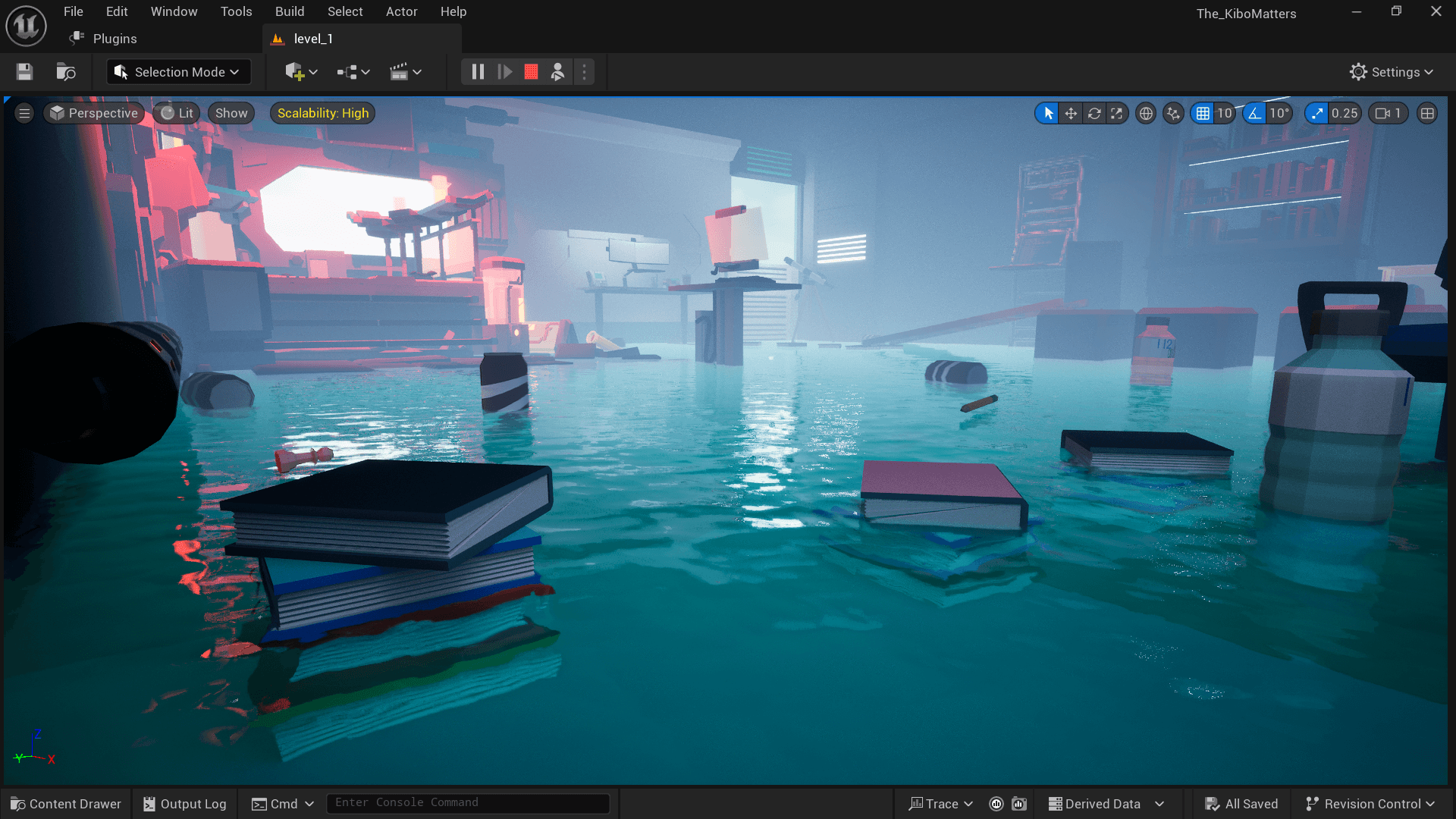


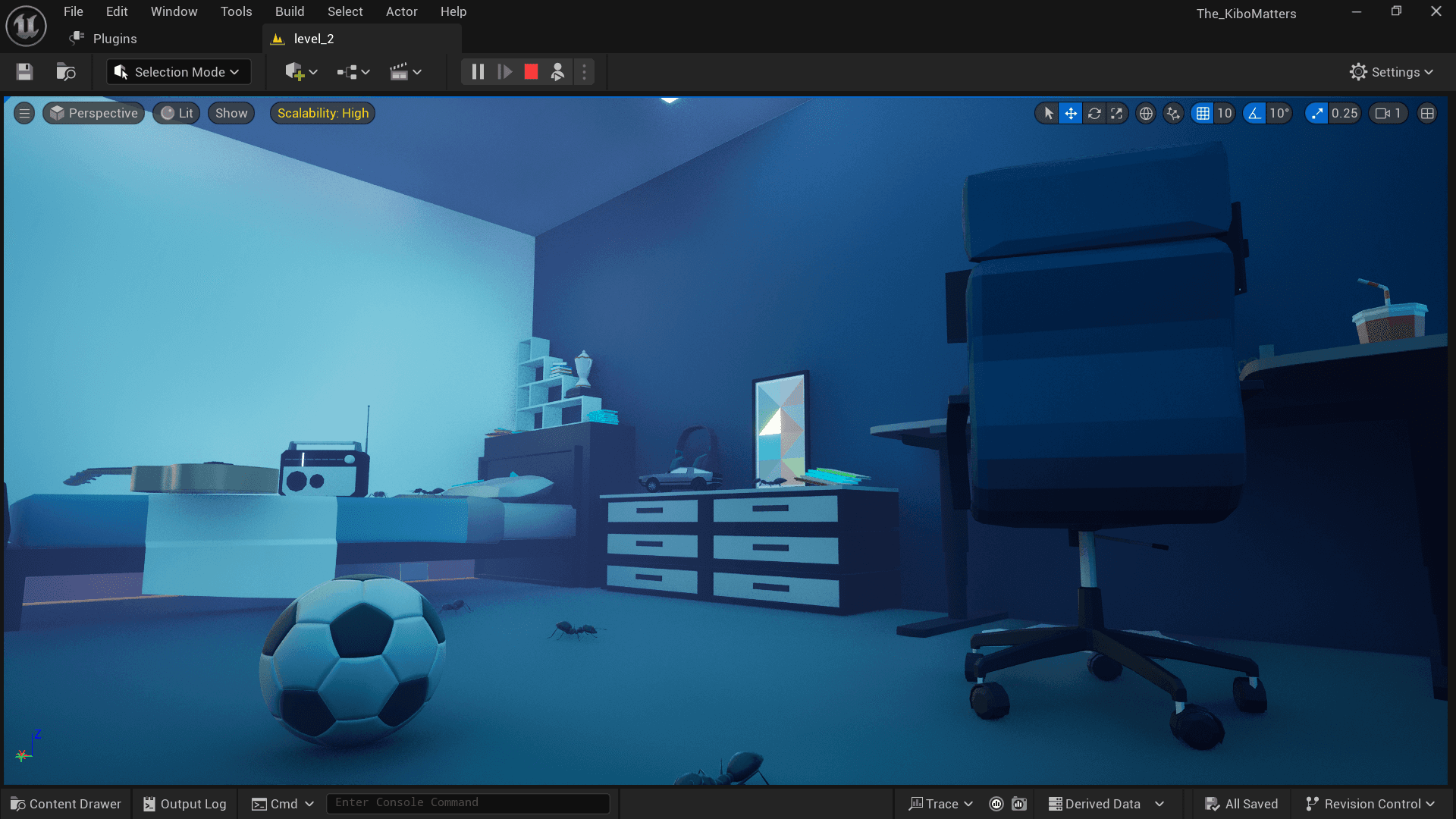


Design Decisions Worth Calling Out
The 100-second timer. This was the hardest thing to balance. Too generous, and the survival tension disappears. Too tight, and exploration feels punishing instead of urgent. We went through several iterations of pill placement and timer length before it felt fair.
Spray-based combat, not melee. We picked a ranged, spray-style weapon for the third level onward partly for thematic reasons (it reads more like "defending yourself" than "attacking"), and partly because it was more forgiving to tune in Blueprint than melee hit-detection.
What This Is — and Isn't
KiboMatters is a playable prototype, not a polished, ready-to-ship title. It was built in a short, high-pressure development window by a three-person team, entirely in Blueprint. That means:
Combat balance and enemy AI are functional, not deeply refined
The four levels exist and are completable, but production values (VFX polish, audio mixing, animation blending) are at a prototype level, not a shipped-game level
There's no multiplayer, no save system beyond the current session, and no mobile/console build — PC only, via the Windows build in the repo
What it does demonstrate: a complete narrative loop from setup to resolution, a working core gameplay mechanic (Size Shift) tied directly to the story's theme, two distinct game modes built on the same systems, and a functioning combat, collision, and real-time damage pipeline built with Unreal's Niagara VFX and Blueprint tools.
Lessons Learned
A simple core loop (explore → find → survive → repeat) can carry a lot of narrative weight if the theme is consistent — we didn't need complex systems to make the tension land
Blueprint-only development is genuinely fast for prototyping, but debugging gets harder as the node graphs grow; a few systems got messy by the end
Splitting work by "whoever's free" instead of fixed roles worked well for a small team and short timeline, but it also meant no one person owned quality control on any one system — something we'd change on a longer project
Playtesting the timer early would have saved us a lot of late rebalancing
Next Steps
If we kept building this out:
More levels — the four-level arc works as a proof of concept, but the story could support more
New enemy types — flying enemies were on our list but didn't make it in
Multiplayer co-op — survival games tend to get more interesting with a second player to coordinate with
Deeper Size Shift interactions — right now it's mostly perceptual; there's room to tie it into puzzle-style level design
Audio and VFX polish — the atmosphere is there, but it needs another pass to feel fully intentional rather than placeholder
KiboMatters was designed and built by a three-person team — Prasād Borade, Yash, and Sonika — in Unreal Engine. Source and build files available on GitHub.
Full set of screenshots: Google Drive folder